The Breathing Room Principle: Why Empty Garden Space Does the Heavy Lifting
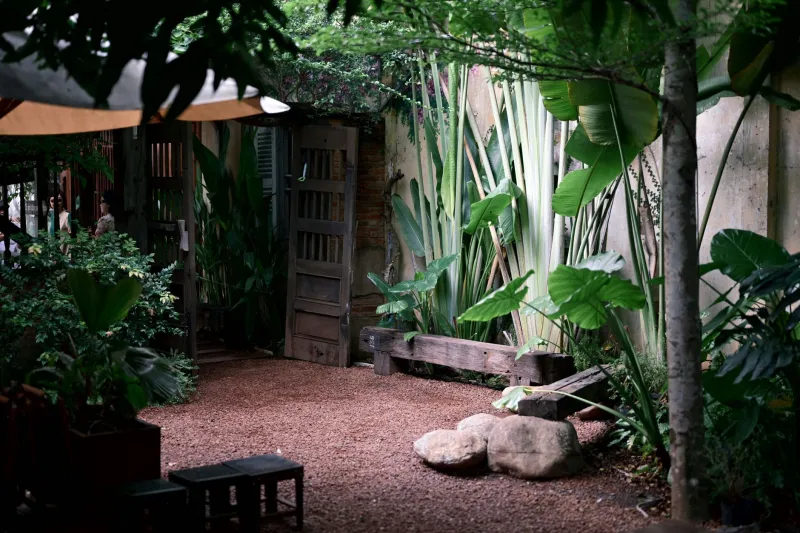
There is a particular instinct that kicks in when a UK gardener stands at the back door with a tray of perennials and a free afternoon: fill the gap. Every border gets another layer, every corner gets a pot, every fence gets a climber. The result can be generous, but it can also be exhausting—a garden that shouts every sentence at once and never pauses for breath.
I saw this recently in a small Victorian terrace garden. The owner had done everything right: good plants, nice pots, a decent bench. But you could not see any of it. We removed a shrub, lifted a run of pots and cleared a rectangle of paving. Suddenly the border had a shape, the seat had a reason and the light had somewhere to land.
That is the case for negative space. Not emptiness for its own sake, but the deliberate use of clear ground, open sky and uninterrupted sightlines to give the rest of the garden room to perform.
Empty space is a material, not a gap
In design terms, negative space is the area around and between things. It is the pause between notes. In a garden, it can be gravel, lawn, paving, water, or simply the clear air between a hedge and a tree. It has colour, texture and weight, even when nothing is growing in it. A pale gravel panel reflects low autumn light. A still water bowl catches the sky. A plain lawn sets off the chaos of a border.
Think of it as a material you choose, not a failure to plant. And like any material, it needs edges. A crisp spade-cut between gravel and border, a single line of setts, a mown edge—these details tell the eye that the clear space is intentional.
What it changes: proportion, light and movement
Negative space is a proportion tool. A border feels wider when it is seen against a clear run of ground. A seat feels more inviting when it is not crammed against a fence. In a small plot, a single clear rectangle can make the whole garden feel less cramped without adding a centimetre of width.
It is a light tool. UK gardens often work with low, slanting sun, especially from October through March. Clearing a shrub or lowering a hedge can let that light reach the house, the patio or a favourite chair. Pale paving and gravel bounce it further.
It is a movement tool. A clear sightline draws the eye—and your feet—through the garden. A path that disappears behind planting is mysterious; a path that never has a clear view is simply frustrating. Negative space gives the eye a destination.
Three blank moves that earn their keep
Gravel panels. A simple rectangle of self-binding gravel or pea shingle can be a low-cost, low-fuss way to create calm. It works well in small courtyards, between raised beds, or as a setting for a single sculpture or pot. Keep the edge sharp and the planting loose.
Lawn as breathing room. A lawn is not automatically boring. A clean shape of grass, with well-defined edges, can be the quiet foil that lets flower borders and trees do their thing. The mistake is treating lawn as leftover space rather than designed space.
Paving with confidence. A small patio does not need a busy pattern. Large-format slabs, set in a simple grid or running bond, give the eye a rest. In tiny gardens, a single material used consistently will nearly always beat a patchwork of changes.
Water, still and simple. A bowl, a trough or a small rill can act as a mirror and a focal point. It does not need to be large. In fact, a modest still surface often reads as more deliberate than a sprawling pond.
Small plots: subtraction beats addition
In a courtyard or a small back garden, every object competes. The answer is rarely another plant. It is usually one clear area that lets everything else settle. Try marking out a rectangle of paving or gravel roughly the size of a dining table—or the space you need to pull out a chair—and keep it clear for a season. You will notice how much more visible the planting becomes.
This does not mean bare. It means edited. A pot, a bench and a simple water bowl can live in that clear space without filling it. The point is that the eye has somewhere to land.
Long, narrow plots: give the eye a place to stop
Long, thin gardens are common in UK towns and cities. The temptation is to fill every metre with a new room. But a series of busy rooms can feel like a corridor of stuff. Instead, keep one long sightline clear from the house to the far end. Let the eye travel. Then place the seat, sculpture or special plant at the end of that view.
You can still have zones. Just make sure each zone has a clear centre, not just a cluttered edge. A narrow garden works best when the middle is open and the edges do the talking.
Audit your own garden with a photograph
Take a photo from the back door and another from the far end. Squint. The areas that blur into visual noise are your candidates for clearing. Look for repeated pots, unused furniture, overcrowded borders and paths that wander without purpose. Remove one thing—just one—and live with the gap for a week. Most people fill it back in too quickly. Give the space time to show you what it wants to be.
Where to stop
Negative space is not an excuse for a sterile garden. It needs contrast: soft planting against hard edge, movement against stillness, colour against calm. Too many clear areas can feel empty; too many focal points can feel frantic. The aim is balance—a garden that has the confidence to leave a little room.
At Fusion Garden Creations, we often say that creative gardens are thoughtfully grown. That thought includes knowing what to leave out. Sometimes the best design move is not another plant, another pot or another path. It is a deliberate blank—a place for light, air and the garden itself to breathe.