Borrowing the Horizon: How to Frame a View You Don't Own
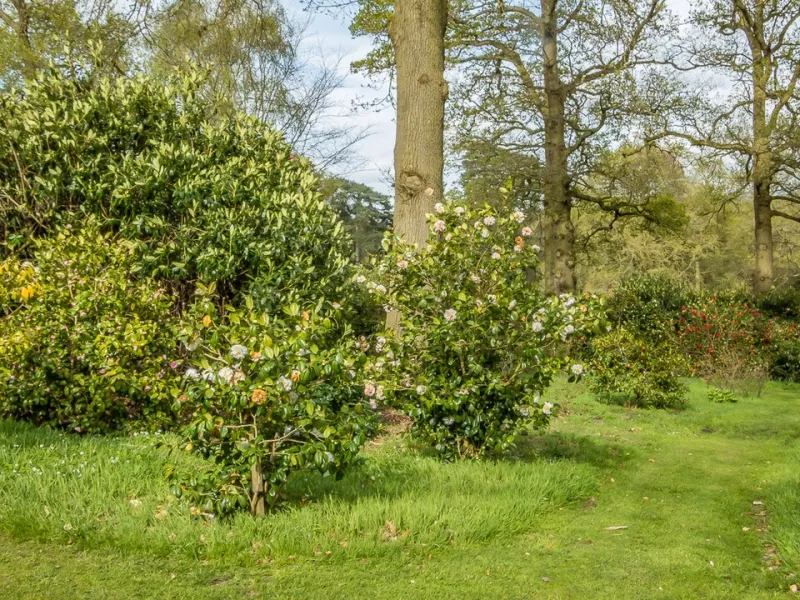
Photo: Ian Capper , CC BY-SA 2.0, via Wikimedia Commons
There's a particular kind of magic that happens when a garden stops behaving like a box. You walk out of the back door, glance up, and instead of a fence and a neighbouring extension you get a slice of hillside, a tower, a run of old rooflines, or simply a lot of uncomplicated sky. Nothing about your plot changed. You've just borrowed the view.
Designers have been nicking views for centuries — Capability Brown did it at a scale that would make your neighbours nervous — but the principle works just as well on a suburban plot in Leeds or a courtyard in Bath. You can't own what's over the boundary. You can absolutely make it part of your garden.
What borrowing a view actually involves
Borrowed scenery is the art of inviting something outside the boundary to do some of the work inside it. That might be a skyline, an ancient hedge, a church tower, a line of poplars, or the way light falls across a distant field in the evening. It even applies to the sky itself: a narrow gap between buildings can become a deliberate slot of cloud and blue if you arrange things around it properly.
The catch is that borrowed views are lazy things. They don't organise themselves. Unless you frame them, anchor them and quietly emphasise them, they'll go unnoticed behind the washing line and the wheelie bins. The job is less about adding and more about directing attention.
Start by standing still and looking up
Before you buy a single plant, spend a week noticing what's actually out there. Stand at the kitchen window with your morning coffee. Sit on the back step at six in the evening. Walk the boundary. Note the moments when something good appears: the top third of a horse chestnut, a spire peeking over a ridgeline of slate, a gap where the rooftops step down and let the sky through.
Then be brutally honest about the rest. That borrowed view usually arrives with a companion — a satellite dish, a tangle of cables, a garage wall the colour of putty. Good borrowing is at least half editing.
Framing devices do the heavy lifting
A frame tells your eye where to look. In a small garden you don't need much:
- A gap in planting. Two upright shrubs or small trees with clear air between them turn whatever sits beyond into a picture. Hazel, yew columns, Amelanchier or multi-stem birch all work.
- A timber or metal arch. Even a plain oak frame across a path reads as a window, and everything past it gains importance.
- A change of level. Steps up to a raised seating area lift the eyeline over the fence and hand the view back to you.
- A seat facing the right way. This sounds almost too simple, but a bench pointed at the good stuff, with the bins moved somewhere else, changes how a garden feels more than any planting scheme.
- A dark backdrop. A deep green or charcoal-painted wall behind lighter foliage makes the space beyond seem further away and more luminous.
Planting as a soft lens
Plants are the gentlest edit available. A loose hedge or a screen of tall grasses blurs the awkward things — next door's trampoline, the substation, the caravan — while leaving the treetops and the sky alone. Think of it as a filter with gaps in it: dense at eye level, open higher up.
For a borrowed treeline, echo it. If the horizon is full of birch and pine, a couple of birches near the boundary knit your garden into the landscape rather than fighting it. Colour repetition works too: a distant band of gorse or beech hedging in autumn becomes intentional if you plant a related tone closer to home.
Structures that point rather than shout
If the view sits above fence height, a pergola with an open, slender top can lift your gaze without blocking it. Slatted screens give privacy where you need it and slots of view where you don't. A simple mirrored panel or a still water bowl placed to catch the sky adds a second, shinier version of the view without any structural fuss.
Just be careful with tall solid screens. They're brilliant for privacy and terrible for borrowing. If a fence has to go up, consider a hit-and-miss design or a post-and-wire run with climbing plants, so the top half stays airy.
Manners, privacy and the neighbourly bit
Borrowing a view doesn't mean leaning over the fence with binoculars. A few sensible ground rules:
- Look, don't loom. Trees and structures near a boundary can feel intrusive even when they're entirely legal. Talk to your neighbour before you plant something that will double in height.
- Check before you cut. You can generally trim what overhangs your side, but roots, height limits and conservation areas all have rules — and a polite conversation beats a dispute every time.
- Don't rely on someone else's tree forever. A borrowed view through a neighbour's ash is a lovely thing and a fragile one. Enjoy it, but plant a fallback so you're not starting again in fifteen years.
- Give as well as take. A well-kept boundary, a bit of screening on your side, and a share of your own blossom and berries makes for much better borrowing.
When sky is the only view you've got
Terraced streets and courtyard plots often have nothing to borrow but weather. That's fine — sky is a generous lender. Keep boundary planting low and layered, avoid a cluttered roofline of satellite dishes and bins, and let taller, airy plants (Verbena bonariensis, bronze fennel, stipa) blur the edge between garden and atmosphere. Cloudscapes do the rest.
A quick checklist for 2026
Before the winter planting season, try this: identify one good view, identify one eyesore, and design for both. Frame the first with two uprights and a seat. Screen the second with something that grows fast but stays light. Then, in June next year, sit down with a drink and check whether your garden now feels bigger than its fence line. Nine times out of ten, it will.
The best gardens aren't the ones with the most in them. They're the ones that know what to point at.