Broad Brushstrokes, Not Confetti: A Better Way to Plant Spring Bulbs
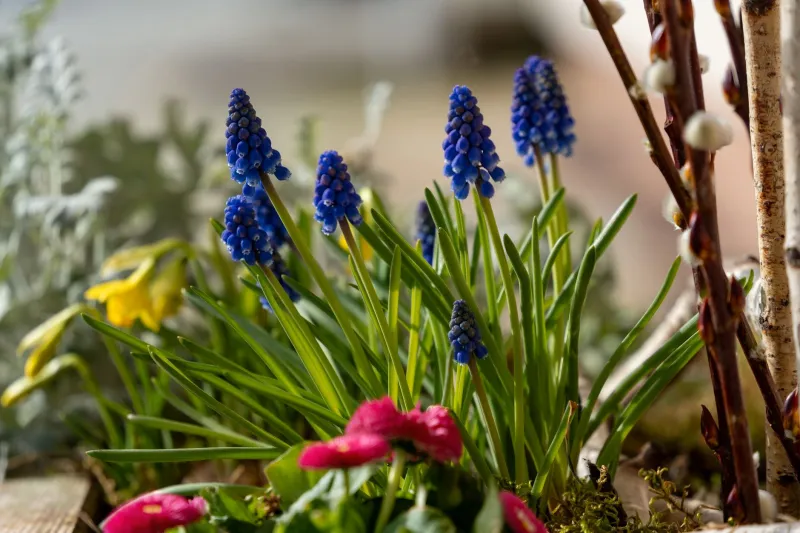
There is a particular look that comes from planting bulbs one here, one there, a few over by the shed. It is not disastrous. It is just a bit like confetti after the party: scattered, well-meant and slightly lost. Spring bulbs work far harder when they are planted in company, in loose drifts that echo the shapes already in the garden. That is the difference between colour that decorates a border and colour that feels as if it belongs there.
November is the right month to be thinking about this. The borders are thinning, the soil is still workable in most UK gardens, and the spring picture is still a sketch. Get the bulbs in now and the decisions you make this month will show up in March and April, when the garden is short of almost everything else.
Why dots disappoint
A single bulb is a small event. Ten bulbs in a tight group are a plant. Thirty in a loose drift are a design decision. That is the shift worth making.
Scattered planting fails for a few reasons. It ignores scale, so the bulbs look timid in a wide border. It ignores repetition, so the eye cannot settle on a rhythm. And it tends to ignore the garden's existing lines, which means the spring colour sits on top of the design rather than growing out of it.
Drifts do the opposite. They follow a curve, a path edge or the spread of a shrub. They repeat. They give the eye something to read at a distance and something to inspect up close. You do not need a grand plan. You need a shape and enough bulbs to make that shape visible.
Think in shapes, not quantities
A useful drift is usually wider than it is tall, a bit irregular, and generous enough to look intentional. In a border, that might mean a ribbon of 20 to 40 bulbs running along the front edge. Around a tree, it might be a rough kidney shape. In a lawn, it might be a long, loose river of crocus that follows the mowing line rather than fighting it.
Odd numbers are not magic. Repetition is. If you have one drift by the patio, consider a smaller echo of it further down the garden. Same bulb, same rough shape, different scale. That is how a spring planting starts to feel like part of the garden's grammar rather than a seasonal add-on.
Spacing matters too. Bulbs planted at exactly the same distance apart look like a municipal bedding scheme. Bulbs planted in twos and threes, with small gaps and occasional clusters, look as if they have naturalised. Aim for a crowd with breathing room, not a grid.
Choose bulbs that suit the place
UK gardens are not one growing condition, and spring bulbs are not one-size-fits-all. Daffodils are forgiving and perennialise well in many soils, especially named varieties such as Narcissus 'Thalia' and 'Actaea'. Tulips are more demanding: they want drainage and a sunny spot, and many are best treated as annuals in heavy clay. Species tulips are a better bet for long-term planting in gritter, leaner ground.
For early colour, Crocus tommasinianus is hard to beat in grass, and Muscari works well at border edges where it can spill a little. Camassia is excellent for damp spots and later colour, while Fritillaria meleagris suits a meadow-ish patch that stays reasonably moist in spring. Alliums are the bridge into May and June, and they look best when allowed to repeat through a border rather than stand alone.
If the garden is exposed, choose shorter, sturdier varieties. If slugs are a persistent issue, avoid the most vulnerable small bulbs and plant with a light grit mulch. None of this is about creating a perfect collection. It is about choosing bulbs that will come back and look as if they have always been there.
Layer the season, not just the colour
A spring display that all happens in one fortnight can feel like a fireworks display: impressive, then gone. Layering is simpler than it sounds. Put early crocus or snowdrops where you will see them from the kitchen window. Follow with mid-season daffodils in the main borders. Then let late tulips, camassia and alliums carry the garden into May.
The trick is to layer by place as well as time. A drift of early crocus under a deciduous shrub will have finished just as the shrub leafs up. A group of daffodils in a border can be underplanted with later perennials that will hide the fading foliage. In lawn, keep the mowing regime in mind: do not cut until the bulb leaves have yellowed, usually about six weeks after flowering. If that sounds untidy, keep the naturalised patch to an edge or a shape you can live with.
Working bulbs into borders and lawn edges
You do not need to empty a border to plant bulbs. Use a trowel or a bulb planter and work between existing perennials, lifting a little mulch and replacing it afterwards. In established borders, avoid digging into woody crowns and big clumps. Plant where the ground will be empty in early spring, such as in front of late-emerging perennials or around the skirts of shrubs.
For lawn edges, lift a flap of turf, loosen the soil beneath, set the bulbs in a loose group and press the turf back. Water if the weather is dry. A light top-dressing of soil or sand will help the patch settle. This is also the moment to decide how the drift meets the edge: a straight line looks deliberate, a soft scallop looks natural, and either can work as long as it is repeated.
Mark the area if you are likely to forget it. A few short sticks are enough. There is no prize for remembering, and there is a small annual tragedy in digging up your own bulbs in February because the border looked empty.
The small decisions that pay off later
Buy enough bulbs to make a shape. Plant in loose groups rather than neat rows. Repeat one or two varieties across the garden so the spring colour has a theme. Choose varieties for your soil and exposure rather than for the picture on the packet. And plant this month, while the soil still has a little warmth in it and the roots can settle before winter.
Spring bulbs are often treated as decoration, something to add colour before the real garden starts. Planted in drifts, they become part of the real garden: a line along a path, a pool under a tree, a river through the lawn. That is the transformation worth making. And it starts with a trowel, a bag of bulbs and a decision not to scatter them like confetti.