Light the Floor, Not the Sky: Garden Lighting That Leaves Room for the Moths

Photo: warm low-level bollard lighting along a garden path at dusk, via www.nio.com
I have a fairly firm view about garden lighting, and it is this: the best-lit gardens are the ones you can barely tell are lit.
Walk down any suburban street in Britain on a winter evening and you'll see the opposite — gardens glowing like airport aprons, trees lit from below as if they're about to be interviewed, white-blue LEDs firing straight at the bedroom windows opposite. It's not atmosphere. It's a floodlit car park with a shrub in it.
And it isn't free, ecologically speaking. Most of our moths, many of our bats, and a decent proportion of our beetles and hedgehogs do their living in the dark. Light at the wrong level, in the wrong colour, for the wrong hours, quietly empties a garden of the things that make it interesting after sunset.
The problem is rarely brightness — it's spill
Almost every lighting complaint I hear is really about glare and spread. A single shielded fitting aimed at a path does more useful work than six unshielded ones pointed vaguely downward, and a fraction of the light escapes into the sky, the hedge and the neighbour's kitchen.
The rule I work to: light the surface, not the space. You want the tread of a step and the edge of a path to be legible. You do not need the volume of air above them to glow.
Practically that means:
- Shielded, downward-facing fittings with a proper hood or louvre.
- Warm colour, 2700K or lower. Amber is better still. Blue-white is both unflattering and much more disruptive to insects.
- Low output. A few hundred lumens, most of the time, is plenty. You'll be surprised how little it takes once your eyes adjust.
- No uplighters in trees. Ever, really. If you want to see the tree at night, put a bench underneath it and let the moon do the work.
Timers, sensors and the switch nobody touches
The single most effective wildlife measure costs about fifteen pounds and sits in a socket: a timer. Lights that come on at dusk and go off at ten, rather than burning until dawn, cut the damage dramatically and save the electricity too.
Motion sensors are useful on the route from the back door to the bin store, but be realistic — a cat will trigger them constantly, and a sensor light that fires at every fox is a nuisance to you and a strobe to next door. If you use one, keep it low, keep it aimed at the ground, and set the duration short.
Dimmable circuits are worth the small extra cost. A garden at eight o'clock, when you're eating outside, wants more light than the same garden at midnight when the last person has gone to bed. Being able to turn it down is the whole trick.
And get the cabling sorted early, in the ground, in a duct, before anything is planted. Retrofitting lighting into a finished garden is expensive and cross.
Leave a corridor of real darkness
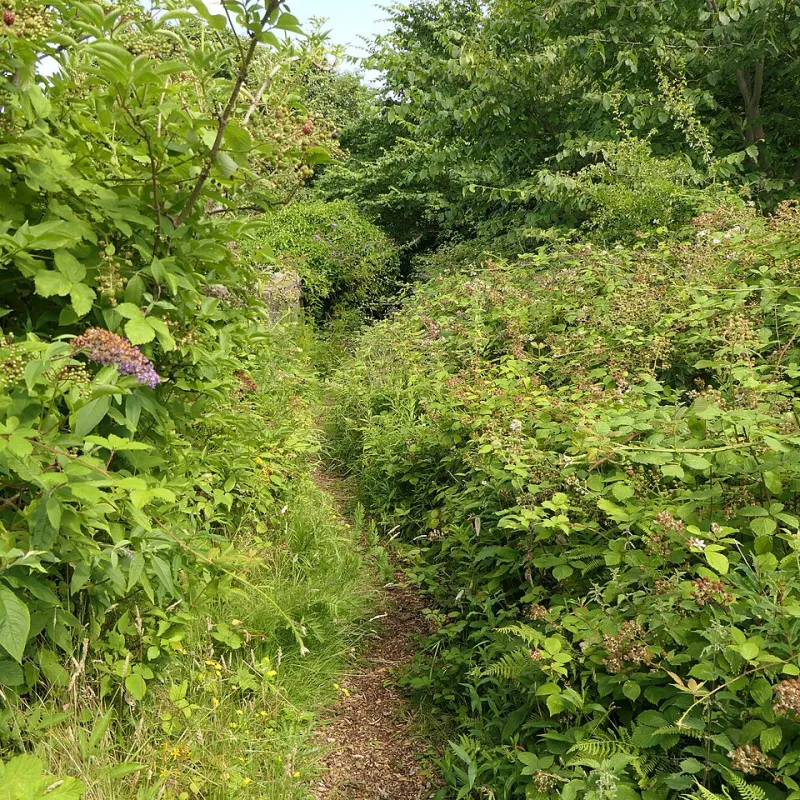
This is the part that gets skipped. A garden lit right the way round is a garden with nowhere for wildlife to go. Moths and bats and beetles need dark routes to move along — along a hedge, along a boundary, from one garden to the next.
So pick the sunniest, most-used part of the garden and light it well. Then pick the far corner, the back hedge, the area beyond the shed, and light it not at all. Pitch dark, permanently. A habitat corridor running along a boundary costs nothing, and it's the reason you'll still see bats overhead in a few years' time.
If your garden's only access is the lit side, add a few unlit gaps in the run — a stretch of path with no fittings between two lit sections. Small dark intervals matter more than you'd think.
And ponds: leave them dark. Lighting a pond is one of the more popular things people ask for and one of the more damaging. The insects emerging from it at dusk don't need an audience.
Safety without floodlighting
People worry, reasonably, about steps and uneven ground. The answer isn't more light, it's better-placed light.
Step lights recessed into risers, low bollards along a path edge, small deck lights set flush in paving — these give you a readable route at ankle height without a wall of glare. Carry a torch for the rest. And keep the fitting heights low, because light at eye level blinds you to everything behind it.
If you have elderly visitors or small children, a single well-aimed fitting at the change of level does more for safety than flooding the whole lawn. Aim for contrast, not coverage.
What I'd actually install
For most UK gardens, a sensible kit is: four to six low, warm, shielded path fittings; two deeper fittings on the seating area; a couple of wall lights by the back door on a timer; and a plug-in festoon or two on a pergola for the evenings you're actually outside. Everything on a timer. Everything dimmable. Nothing pointed up.
The pleasure of a well-lit garden is that it looks smaller, softer and more mysterious than it does by day — the path disappears into shadow at the end, the hedge reads as a dark mass, and the moths come back. Light the floor. Leave the sky alone.