Room to Breathe: Twelve Design Moves That Make a Tiny UK Garden Feel Twice Its Size
Small gardens often get treated as the consolation prize in UK gardening. You see the glossy spreads with sweeping lawns and orchard rows, then look at your own 30m² patch behind the kitchen and wonder where the creativity is meant to go. But after designing compact plots from Bristol to Glasgow, we have stopped thinking of small as a limitation. It is simply a different brief. This is our 2026 small-garden manifesto: twelve moves that make a plot under 40m² feel deliberate, generous and much bigger than its measurements.
1. Start with a use map, not a shopping list
Before you buy a single pot, decide what the garden needs to do. Dining, sitting, storage, drying washing, somewhere for the bins, a bit of play, a quiet corner for a cup of tea. Draw the plot on a piece of paper and bubble in those uses. Most small gardens fail because they try to do everything in the same square metre. A simple use map shows you where the overlaps are and where a bit of clever layering can solve two problems at once.
2. Zone with level changes and surfaces
You do not need walls to create separate areas. A single step, a strip of gravel, a change from paving to decking or a low timber edge can signal that one part of the garden is for eating and another is for sitting. In small plots, these changes do the work of rooms without eating up space. Keep the levels shallow and safe, and make sure any step is visible in low light.
3. Keep the middle clear
A common mistake in compact gardens is to push a border into the centre and leave the edges bare. It makes the space feel like a corridor with obstacles. Instead, push planting to the boundaries and keep the middle as open as possible. A clear route from the back door to the far end will make the garden feel longer. Curved beds can soften the shape, but they should still leave a generous path.
4. Climb the walls
When floor space is tight, the vertical plane is your best friend. Trellis, wires, wall-mounted planters and shelving can turn a plain fence into a green wall. Climbers such as jasmine, clematis and climbing roses add height without taking up root space. Wall shrubs, ferns and small trees in pots can also lift the eye. Just make sure anything fixed to a fence is attached securely and does not trap moisture against the wood.
5. Build storage into the furniture
Small gardens need somewhere to put things, and a shed can dominate the plot. Look for benches with lift-up seats, built-in bike stores, slimline tool boxes and bin screens that double as planters. A custom bench along one wall can provide seating, hide clutter and give you a shelf for drinks. If you are buying new furniture, measure the storage first and the seating second.
6. Choose permeable paving that earns its keep
Solid concrete is rarely the answer in a small garden. It sends rainwater into drains and makes the space feel hard. Permeable paving, gravel, clay pavers or resin-bound surfaces allow water to drain away and can be laid in patterns that guide the eye. Gravel is inexpensive and good for informal plots, but it needs edging to stop it migrating. Clay pavers cost more but age beautifully and can be reused.
7. Repeat a small palette of plants
A tiny garden can easily become a plant collector's jumble. Repetition is what makes a small space feel calm and considered. Choose three to five key plants and repeat them through the borders. For example, a white Japanese anemone, a dark purple salvia and a soft green grass can carry the whole garden. Add seasonal bulbs and a few pots for variety, but let the core palette do the heavy lifting.
8. Plant in layers, not rows
Think of a border as a sandwich: bulbs at the bottom, low perennials in the middle, shrubs and climbers behind, and a small tree or tall grass for height. Layers give you more interest per square metre and help suppress weeds. They also support wildlife, because different heights offer shelter and food. Even a narrow border can hold three layers if you choose compact varieties.
9. Treat containers as architecture
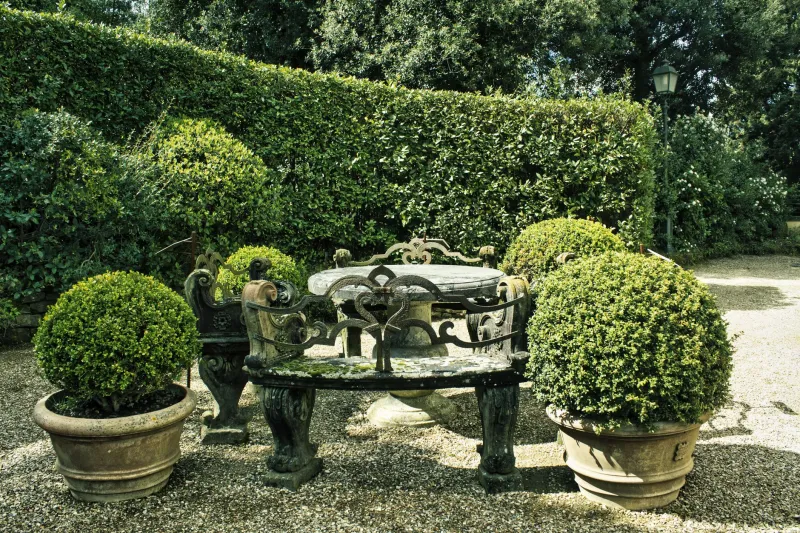
Small pots dotted about can make a garden look cluttered. A few large containers, in the same material and colour, can act like columns or sculptures. Use them to mark a doorway, frame a seat or add height where the border is too narrow. Big pots also hold moisture better than tiny ones, which matters in a UK summer. Choose frost-proof containers and raise them on feet for drainage.
10. Light the boundaries, not the whole garden
Lighting can make a small garden feel magical, but floodlights will make it feel like a car park. Use warm, low-level lights along the path, behind a seat or aimed up a climber. Solar lights have improved, but mains-powered fittings with a timer are more reliable in winter. Keep the light soft and avoid pointing it at windows or neighbouring gardens.
11. Hide the practical stuff on purpose
Bins, washing lines, compost caddies and bike stores are part of real gardens. Do not pretend they are not there. Screen them with a slatted fence, a planter or a purpose-built store. A washing line can be a retractable one that disappears when not in use. A bin store can be a simple timber box with a living roof. The aim is not to hide every trace of daily life, but to stop the practical stuff from dominating the view.
12. Leave room for change
A small garden should not be finished in one weekend. Leave a patch for annuals, a pot that can be swapped for the season, or a corner where you can try something new. Gardens are more enjoyable when they are allowed to evolve. A little empty space also makes the planted areas feel more generous.
Before and after: a 34m² plot in Leeds
One recent project was a 34m² back garden behind a terraced house. Before, it was a square of tired lawn, a shed that blocked the back fence, wheelie bins by the kitchen door and a washing line strung across the only sunny spot. The garden felt smaller than it was because every surface was doing one job badly.
After, the same plot has a small dining terrace by the house, a gravel path down one side, a bench with storage along the other, and planting pushed to the boundaries. The shed was replaced with a slimline bike and tool store, the bins are behind a slatted screen, and the washing line is retractable. Climbers cover the back fence, a small tree adds height, and warm path lights make the garden usable after dark. The lawn is gone, but the garden feels larger because the eye can travel from the table to the far border without stopping at clutter.
None of these moves require a bigger garden. They require a clearer plan. Start with how you want to use the space, keep the centre open, build upwards and make every object earn its place. A small garden can be the most creative garden you own.