The Ten-Foot Workhorse: Making the Side Return Feel Like Garden, Not Corridor

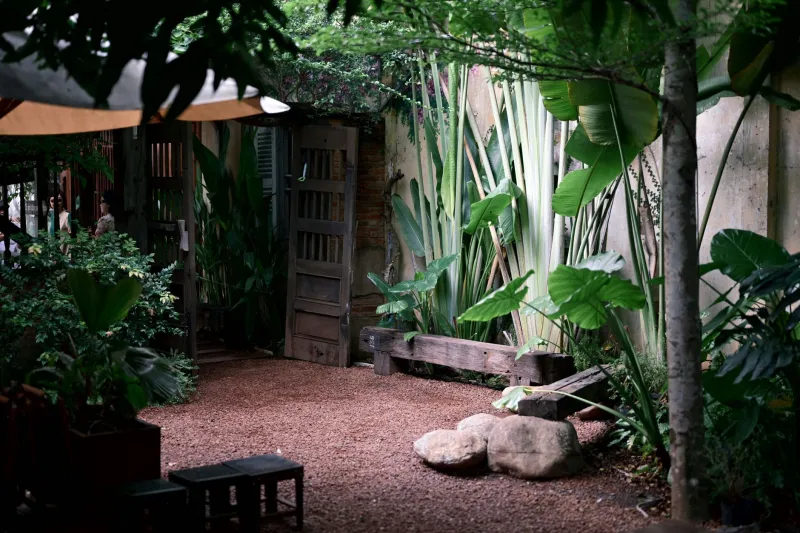
Photo: narrow side return garden path UK terraced house planting, via 64.media.tumblr.com
Most UK side returns are not designed so much as inherited. A strip of concrete, a fence on each side, a gate at the front, a downpipe somewhere in the middle, and a wheelie bin that has to get past all of it. It is the part of the garden nobody photographs. And yet, for plenty of homes, it is the hardest-working ten feet on the property. It takes the bins, the bikes, the boot scrape, the recycling, the odd bag of compost, and the route from front to back. Treating it as leftover space is a design choice, just not a very good one.
The trick is to stop asking what the side return looks like and start asking what it does. Once you know that, the look tends to follow.
Start with the jobs, not the plants
Before anything else, walk the strip with a notebook and list every job it performs. Does it need to move two people side by side, or just one? Do the bins come out on a Tuesday night? Is there a bike that needs to be lifted over a step? Are there gullies, manholes, meter boxes or service runs that must stay accessible? Is there a washing line, a tap, a shed door, a side gate that sticks in damp weather?
This sounds dull, but it saves a lot of expensive mistakes. A side return that is beautiful but cannot get a bin past a climbing rose is not a successful side return. Function first is not a compromise here; it is the whole point. The best narrow gardens feel calm because the awkward stuff has been given a proper home.
Light is the first material
Side returns are usually shady, and often damp with it. That is not a problem to be fought; it is a condition to be used. Pale fences, light gravel, and a paving choice that does not turn black in winter will all lift a narrow strip. A wall-mounted mirror can bounce light around a corner, though it needs to be safely fixed and positioned where it will not dazzle anyone or reflect a neighbour’s window.
If the strip runs north to south, expect one side to be much brighter than the other. Plant for the shade on the dark side and keep the sunny side for herbs, strawberries or a warm seat if there is room. If it runs east to west, the far end may be the only place with real sun. That is worth knowing before you order a shed.
Drainage has to be deliberate
Side returns collect water. Roof downpipes, hard surfaces, a slight fall towards the house, and a narrow gap between fences all add up. Any design needs to keep water moving away from the building and away from next door. Do not raise paving above the damp-proof course, do not bury gullies, and do not assume gravel is a drainage solution if the ground beneath it is compacted clay.
A shallow channel or a small planted soakaway can make a wet strip feel intentional rather than neglected. Permeable paving, set on a proper sub-base, is often a better choice than a sealed slab path. If the strip is very wet, a rain garden planted with moisture-loving perennials can turn a puddle into a feature, provided it is positioned where it will not flood the house or block access. In a narrow space, drainage is not a hidden detail. It is the difference between a usable route and a mossy obstacle course.
Make the path feel like somewhere to be
A side return path should not be a ribbon of leftover concrete. It should have a clear width, a sensible surface, and a reason to feel connected to the rest of the garden. Where possible, use the same paving family as the main garden so the eye reads one space rather than a corridor and a yard. If budget is tight, repeat the colour rather than the exact product.
Width matters. Around 900mm is a workable single-person route; more if bins, bikes or a wheelchair need to pass. Turning space at the gate and at the back door is just as important as the path itself. A slight widening halfway along can give you a place to stand, set down a bag, or tuck a pot out of the way. That small bulge in the plan often does more for the feel of the space than any ornament.
Storage that earns its keep
A side return is an outdoor utility room, so give the utility a proper address. A slim bike store, a ventilated bin store, or a bench with lift-up storage can remove the visual clutter that makes the strip feel neglected. Keep lids accessible, allow air to move, and check that hinges and locks will not seize in wet weather. A simple covered store for tools and shoes near the back door can be worth more than another metre of planting.
Do not cram every item into the narrowest point. Put the bulky storage nearest the gate or the back door, whichever makes the weekly routine easier. The middle of the strip should stay clear. If the bins have to travel, they need a smooth, firm surface and no tight corners.
Privacy without building a tunnel
Side returns often look straight onto a neighbour’s wall or a front street. Screening helps, but solid fencing on both sides can make the strip dark and airless. A mix of trellis, climbers, and taller planting gives privacy without closing the sky. Check height rules and talk to neighbours before adding anything ambitious. A side gate should be secure but not so heavy that it is awkward to use every day.
Planting for a narrow strip
Narrow planting works best in layers. Climbers give height without taking floor space: jasmine, climbing hydrangea, or a restrained rose on the sunny side. Shade-tolerant ferns, epimediums, hellebores and grasses fill the ground layer. Repeated pots can be moved for bin day and refreshed through the seasons. Herbs near the kitchen door are practical, but they need light and drainage, so be honest about the aspect.
Avoid plants that sprawl into the route or drop slippery leaves on the path. In a side return, good manners matter. A plant that looks lovely in a border can become a nuisance when it is brushing against a coat every time someone walks past.
The before-and-after test
Before: broken concrete, a dark fence, a bin, a bike, and a drain you cannot reach. After: a firm path with a gentle fall, a ventilated bin and bike zone, a clear route, a pale fence, a climber, a few shade plants, and a light that comes on when you come home. The space has not got bigger. It has got clearer.
That is the side return in a nutshell. It is not a garden snippet that failed to become a garden. It is a working strip that can be designed with the same care as a border or a terrace. At Fusion Garden Creations, we like to think of it as the ten-foot workhorse: unglamorous, hard-working, and much better looking when someone finally gives it a proper job description.