Paws Before Paving: Rethinking the Plot From Six Inches Off the Ground
Every dog garden redesign I've worked on has started with an apology. Sorry about the lawn. Sorry about the back door. Sorry about the crater under the fence where the fox goes past at four in the morning. And every single time, the apology turns out to be the most useful design brief in the house.
Because a dog tells you things a mood board can't. It tells you which corner floods, which path gets used twenty times a day, where the sun actually lands at three in the afternoon, and which bit of the garden you've been mentally paving over for years without noticing. Design from six inches off the ground and the human garden tends to improve as a side effect.
Start with the running lines, not the borders
Before a single plant goes in, walk the garden the way the dog does. Out of the back door, hard left, along the fence, a lap of the lawn, back to the door. That's the circuit. It's almost always a loop, and it's almost always on the shortest line between two points you'd never have chosen yourself.
Design that loop deliberately. If the dog is going to cut the corner of every bed, either put a path there or widen the bed until it's not a corner any more. The single biggest cause of muddy, chewed, patchy gardens isn't dogs — it's a layout that forces a fast-moving animal through soft ground twice a day in January.
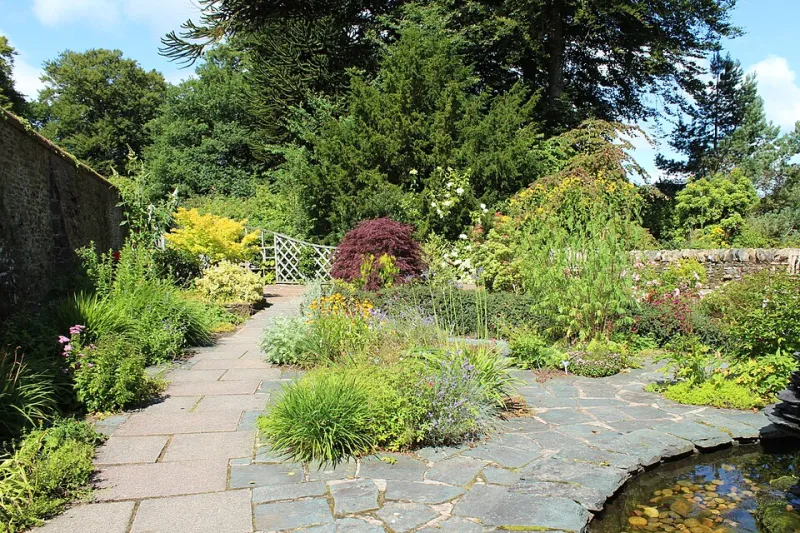
So: give the loop a hard edge. A run of setts, a mown grass path through longer planting, a strip of self-binding gravel. Something that says this is the fast lane and takes the traffic off everything else.
Surfaces that still look like a garden in February
Lawn is lovely and hopeless in equal measure. If you want to keep it, go for a hard-wearing rye-heavy mix rather than a fine ornamental blend, and accept that shade plus wet plus a large spaniel equals mud.
Practical options that don't feel like a car park:
- Resin-bound or permeable paving on the main route. Warm-toned aggregate, gentle curves, no ruts.
- Hoggin or self-binding gravel for secondary paths. Cheap, kind to paws, and it knits into planting beautifully.
- Bark and woodchip in the bits that get chewed. Cheap to top up, easy to hose down.
- Reinforced grass or a clover lawn where you want green but need toughness.
What I'd avoid: pea gravel (it balls up under paws and ends up in the house), large-format smooth paving in shade (a skating rink by November), and any loose mulch that a dog will scatter across three rooms. Cocoa shell mulch is a hard no — it's genuinely toxic to dogs and it smells like chocolate, which is a cruel combination.
The planting brief nobody else gives you
Roughly speaking, the plants that cause the most trouble are the ones gardeners love most. Yew, laburnum, foxglove, aconitum, lily of the valley, autumn crocus, oleander. None of them need banning from a garden with a dog in it — most dogs ignore them entirely — but they shouldn't be in the chewing zone, which means not right by the door, not at nose height along the run, and not where a puppy is going to test everything.
What dogs actually interact with is texture. Long grasses to push through. Strap-leaved things that spring back. Low shrubs with a bit of give. A dog charging through a stand of miscanthus looks fantastic and does no harm at all, whereas the same dog through a delphinium bed is a small tragedy.
Plant in layers and raise the beds. A 300mm sleeper edge is enough to keep most dogs out of the soil and gives you a clean line to sweep against. It also means you can grow the soft, frothy, slightly fragile things you actually want, because they're behind a small wall.
The ten minutes after every walk
This is where the design either works or quietly ruins your hallway.
Think about the sequence: gate, path, door. Somewhere in there needs to be a place to stop. A length of grit or gravel just outside the door acts as a boot-scraper for paws. A tap with a short hose bib, mounted at dog height rather than knee height, saves your back. A mat that drains, not one that holds water like a sponge. If you've got the space, an outdoor dog shower plumbed into the outside wall is one of those additions people describe as life-changing, and they aren't exaggerating.
Inside, a washable floor covering at the threshold rather than a rug that migrates. Microcement, tile or a sealed stone all wipe clean. If you have a utility or boot room, treat the door to it as the real garden entrance and design the outside path to lead there first.
Enrichment is a design brief, not a toy
A bored dog redesigns your garden for you, and not sympathetically. So build the interest in.
A digging pit is the classic, and it works — a sunken sandpit or a bordered bed of soft soil in a corner, kept distinct from the beds you care about. It reads as a deliberate feature if you edge it properly, and the dog learns the difference within a fortnight.
Sniff stations: a low planter of thyme, oregano, mint and lemon balm at nose height by the door. Timber logs laid in a heap. A shallow water bowl set into the paving so it doesn't skate across the patio. A bench with a gap underneath, because a dog wants a den with a view.
And shade. Real shade, at ground level, in the afternoon. A small tree, a pergola, a corner that stays cool. In a hot summer this stops being enrichment and starts being welfare.
The compromises worth making
Here's the honest bit. If you design for the dog first, you lose something. Probably a perfect lawn. Probably a couple of metres of border. Probably the rose you've been coveting since 2019.
What you gain is a garden that actually gets used — where the back door stays open, where the dog has a route and a job, where the planting survives and the mud stays outside. It's not a compromise so much as a trade you'd make again. The trick is to make it look intentional, because a garden built around a real life always does.