Soft Meets Sharp: Blending Cottage Planting With Modern Hard Landscaping in One Coherent Garden
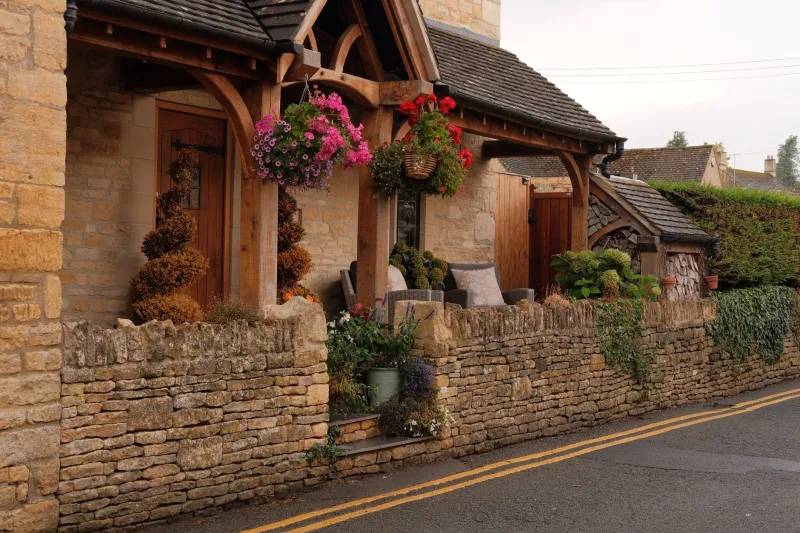
Some of the best gardens in the country are quietly refusing to pick a side. A blowsy border of verbena and roses slumped against a razor-straight run of porcelain paving. A rendered wall doing nothing except looking calm while alliums flop in front of it. On paper it should be a mess. In practice it is often the most interesting thing on the street.
The trouble starts when the blend stops blending. You have seen it: a neat contemporary terrace at the back door, then a scruffy cottage border further down, then a bit of lawn, then something else. Two gardens in one plot, and neither of them talking to the other. Fusion is not the problem. Joinery is the problem.
Start with one thing that repeats
Before you choose a single plant, choose a single connector. One material, one colour, one plant genus that appears on both sides of the conversation.
If your hard landscaping is grey porcelain, let grey turn up in the planting — santolina foliage, lavender stems, the felted leaves of artemisia. If your boundary is London stock brick, let the same brick reappear as a low edging or a run of stepping stones through the border. If your planting leans on a particular white rose, repeat that white somewhere near the crisp lines: foxgloves against the rendered wall, white achillea beside the path.
The connector does more work than any amount of clever design. It tells the eye that these two languages belong to the same speaker. Without it, you are hoping the visitor will do the joining up themselves, and they usually will not.
The rough 70/20/10 split
This is not a law, more a way of stopping yourself from hedging. Decide which language leads, then commit to it at roughly seventy per cent of the plot. The other style takes about twenty per cent as a counterpoint. The last ten per cent is for something that belongs to neither — a mature multi-stem, a sculpture, a really good bench, a single enormous pot.
So if modern hard landscaping is leading, seventy per cent of what you see is clean paving, geometric edges, rendered surfaces, clipped structure. Cottage planting comes in as a strong, clustered twenty per cent rather than a sprinkle. If the loose romantic planting leads, then the hard landscaping becomes the twenty per cent punctuation: one crisp path, one sharp retaining edge, one clean threshold.
The failure mode here is the fifty-fifty split. Equal halves do not read as fusion, they read as indecision. Minority styles only look deliberate when they are confident and gathered together, not dotted about like seasoning.
Let hard landscaping hold the planting, and planting spill over the hard
Hard landscaping gives loose planting something to fall against. A rendered wall is a backdrop. A clean path edge is a line for nepeta to tumble over. Soft planting, meanwhile, stops hard surfaces feeling like a car park. The relationship should work in both directions, which means you are designing the two together rather than laying the paving and then wondering what to plant behind it.
One practical move: cut a narrow channel of planting straight through a paved area. Not a border, not a bed — a seam. Twenty or thirty centimetres wide, filled with something tall and airy like verbena bonariensis or knautia, and the paving suddenly stops being a surface and becomes a frame. It is a small intervention that does a great deal of fusion work.
Where to let the hard line stay hard
Do not soften everything. If every corner is chamfered and every edge has a plant flopping over it, the garden turns to porridge and the cottage planting starts to look neglected rather than romantic.
Keep the hard line where it matters: along the house, along the boundary, along the main axis of the garden. Let one threshold be genuinely crisp — a step, a doorframe, a change of level. The contrast is the point. A single uncompromising straight line makes the looseness elsewhere read as a choice rather than an oversight.
A worked example: the small urban back garden
Take a typical six-by-nine-metre terrace garden. Existing: grey porcelain paving wall to wall, rendered boundary walls, one sad shed.
Keep the paving, but reduce it to a clean rectangle about three by four metres off the house. Cut a planting seam through it, running towards the boundary. Paint the render a warm off-white rather than brilliant white, which is friendlier to plants. Along the two side boundaries, put in the cottage planting — roses, geraniums, alliums, knautia — but hold it at the front with a clipped yew or box hedge, roughly forty centimetres high, running straight. That hedge is the fusion in miniature: a hard line made of soft material.
Repeat the paving as a set of large square stepping stones leading into the planting, so the hard material follows you into the soft zone. Repeat the wall colour in the planting with white foxgloves and white roses. Repeat the hedge shape once more in a single clipped ball near the seating area.
Nothing in that garden is unusual on its own. The repetition is what makes it read as one place. Take out the hedge and the stepping stones and the white planting, and you are back to two gardens arguing.
When fusion genuinely fails
It fails when the two languages are kept in separate rooms with a hard border between them — a wall, a step, a change of level that says this is now the modern bit and this is now the cottage bit.
It fails when there are too many materials. Three paving types, four wall finishes and a gravel path is not fusion, it is a sample board.
It fails when the cottage planting is dead tidy, because tidy cottage planting looks like a municipal roundabout. And it fails when the hard landscaping is fussy — patterned paving, decorative edging, ornate fencing — because then there is no calm partner for the planting to work against.
Most of all, it fails when the hard landscaping goes in last, as an afterthought, once the planting has already been designed. Fusion is a conversation. You cannot have it with yourself.